Complete Guide to Flower Color Theory and Palette Design
12 min read
Contents:
- The Color Wheel: Your Most Useful Garden Tool
- Warm vs. Cool: The Temperature Divide
- The Four Core Color Harmonies for Flower Palette Design
- Complementary Harmony
- Analogous Harmony
- Triadic Harmony
- Split-Complementary Harmony
- Color Theory vs. Color Trend: An Important Distinction
- Understanding Value and Saturation in Flower Selection
- Value: Light and Dark
- Saturation: Intensity and Chroma
- Applying Color Theory to Real Garden Situations
- Single-Season Borders
- Four-Season Gardens
- Cut Flower Arrangements
- White, Black, and Green: The Neutrals That Change Everything
- Practical Tips for Building Your Own Flower Color Palette
- Frequently Asked Questions
- What is flower color theory?
- What is the easiest color combination for a beginner flower garden?
- How do I use the color wheel to pick flowers that go together?
- Do white flowers go with everything?
- What’s the difference between color harmony and color contrast in garden design?
- Take Your Palette from Concept to Planting Plan
Humans can distinguish approximately 10 million distinct colors — yet most gardeners work from a handful of favorites and hope for the best. That instinct isn’t wrong, but it’s leaving a lot of beauty on the table. A basic understanding of the flower color theory guide below will transform the way you see your beds, borders, and bouquets. Not by making things more complicated, but by giving your eye a map it can actually follow.
This guide is for gardeners who’ve moved past “I just plant what I like” and want a repeatable system. You already know the difference between a determinate and indeterminate tomato. Now let’s apply that same analytical energy to color.
The Color Wheel: Your Most Useful Garden Tool
The color wheel was formalized by Isaac Newton in 1666, but its application to garden design didn’t get serious academic treatment until Gertrude Jekyll’s late-19th-century writings on the herbaceous border. She understood intuitively what color scientists would later quantify: the human visual system perceives colors relationally, not in isolation. A yellow marigold looks different next to a blue salvia than it does next to an orange zinnia. Same flower. Completely different effect.
The standard horticultural color wheel organizes hues into three tiers:
- Primary colors: Red, yellow, blue. These can’t be mixed from other colors.
- Secondary colors: Orange, green, violet. Each sits between its two parent primaries.
- Tertiary colors: Red-orange, yellow-orange, yellow-green, blue-green, blue-violet, red-violet. These give you the nuance that separates interesting gardens from merely colorful ones.
Most flower colors in nature land in the tertiary range — think magenta (red-violet), coral (red-orange), or chartreuse (yellow-green). Understanding where a bloom actually sits on the wheel, rather than rounding it to the nearest primary, is the single upgrade that makes color combinations click.
Warm vs. Cool: The Temperature Divide
The wheel splits cleanly into warm (red through yellow-green) and cool (green through red-violet) halves. This temperature divide has practical garden consequences. Warm-toned beds — reds, oranges, golds — visually advance toward the viewer, making a space feel smaller and more energetic. Cool-toned beds — blues, purples, soft pinks — visually recede, making a small space feel larger and a hot garden feel calmer.
A simple rule from landscape designers: place warm colors at the back of a long border to pull the eye forward, and cool colors at the back of a short space to push the boundaries out. This one trick can make a 20-foot border feel like 30.
The Four Core Color Harmonies for Flower Palette Design
Harmony in color theory means a combination that the eye reads as intentional and pleasing. There are four arrangements that reliably work in garden and floral contexts. Every designer’s palette you’ve ever admired falls into one of these categories.
1. Complementary Harmony
Complementary colors sit directly opposite each other on the wheel. The classic garden pairings: purple + yellow, orange + blue, red + green. These combinations generate the highest contrast available without using white or black, which is why they’re used in sports team logos, national flags, and, yes, the most photographed garden borders in the world.
At Hidcote Manor Garden in England — one of the most influential garden designs of the 20th century — the famous Red Borders work precisely because they’re backed by deep green yew hedging. That’s a complementary scheme with one partner fully saturated and the other desaturated into a neutral. You can replicate this logic at home: plant ‘Mystic Spires’ blue salvia in front of orange ‘Profusion’ zinnias and watch both colors vibrate.
One caution: full-saturation complements (a fire-engine red next to a traffic-cone orange’s opposite) can feel jarring at scale. Desaturate one partner — choose a dusty purple instead of vivid violet, or a butter yellow instead of chrome yellow — to get drama without aggression.
2. Analogous Harmony
Analogous schemes use three to five colors that sit adjacent on the wheel. A coral-peach-salmon-soft-orange border. A lavender-violet-blue-purple sequence. These are the palettes that feel immediately sophisticated because they mirror how color shifts occur in nature — in a sunset, in autumn foliage, across a single peony petal.
The practical limit for analogous schemes is temperature drift. If your “analogous” palette accidentally crosses the warm-cool divide — say, yellow-green bleeding into blue-green — the combination can feel muddy rather than cohesive. Keep all your analogous selections on the same temperature side of the wheel, or limit your range to no more than 90 degrees of arc on the circle.
3. Triadic Harmony
A triadic scheme uses three colors spaced evenly around the wheel — 120 degrees apart. The primary triad (red, yellow, blue) is the most familiar. In garden terms: red ‘Knock Out’ roses, yellow ‘Moonbeam’ coreopsis, and blue ‘Walker’s Low’ catmint. This combination covers a lot of spectral ground while remaining balanced because no one color dominates the temperature conversation.
Triadic schemes work best when you give one color clear dominance (roughly 60% of the planting area), use a second as support (30%), and treat the third as a true accent (10%). This 60-30-10 ratio applies to interior design, graphic design, and garden design for the same neurological reason: it matches how the eye naturally wants to scan and rest.
4. Split-Complementary Harmony
This is the complementary scheme with the edge sanded off. Instead of pairing a color with its direct opposite, you pair it with the two colors flanking that opposite. Example: instead of yellow + purple, use yellow + red-violet + blue-violet. You get most of the contrast punch with significantly less visual tension. It’s a forgiving palette for gardeners who love drama but find pure complementary schemes a little relentless.
Split-complementary is particularly useful in cut flower design, where you’re working at close range. A yellow sunflower with red-violet lisianthus and blue-violet veronicastrum is an arrangement that reads as confident rather than chaotic.
Color Theory vs. Color Trend: An Important Distinction
This is worth addressing directly because the confusion is widespread. Color theory is the underlying system — the wheel, the harmonies, the physics of how colors interact perceptually. It doesn’t change. Color trends are what Pantone announces each year, what shows up in wedding mood boards, and what garden centers stock heavily for two seasons before rotating out.
Trends are fine. Leaning into a Pantone “Mocha Mousse” or “Peach Fuzz” moment is a legitimate way to make your garden feel current. But trends are cosmetic. If you understand the underlying theory, you can interpret any trend palette through the harmony framework and predict whether it’ll actually work in your specific light conditions, with your existing plantings, at your scale. Theory gives you judgment. Trends give you inspiration. You need both.
A practical example: the “cottagecore” trend pushed soft, desaturated pastels heavily from 2020 onward. Beautiful in principle. But desaturated colors lose contrast at dusk and in low-light gardens. If your primary viewing window is evening entertaining, a pure pastel analogous scheme will disappear on you. Color theory tells you to either add a white accent (which holds light) or shift toward slightly higher-saturation versions of your chosen pastels.
Understanding Value and Saturation in Flower Selection
Hue — the position on the color wheel — is only one of three dimensions of color. The other two matter enormously in garden design and are frequently overlooked in a basic flower color theory guide.
Value: Light and Dark
Value describes how light or dark a color is. A pale pink and a deep burgundy are both red-family hues, but their values are completely different. High-value (light) colors advance visually and read well from a distance. Low-value (dark) colors — burgundy, near-black ‘Queen of Night’ tulips, deep chocolate cosmos — add depth and drama up close but can visually disappear against a shadowed fence or dark mulch at 20 feet.
A rule of thumb from floral designers: use dark-value flowers at the center or focal point of an arrangement (physical or planted), where the eye naturally lingers. Use light-value flowers at the edges, where you need them to hold the boundary of the composition.
Saturation: Intensity and Chroma
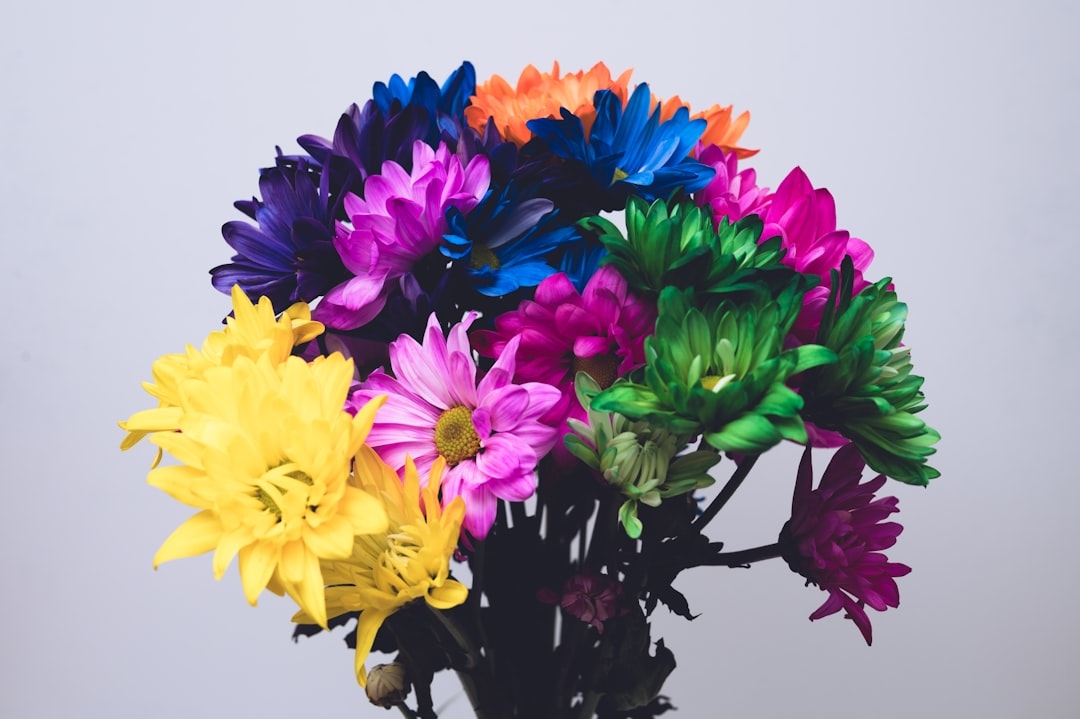
Saturation measures how pure or muted a color is. A fully saturated red is fire-engine. A desaturated red is brick, dusty rose, or burgundy. Nature rarely produces fully saturated flower colors — that electric magenta of a bougainvillea is an outlier. Most garden flowers land in the medium-saturation range, which is part of why they feel harmonious even in mixed plantings.
The key practical insight: colors at similar saturation levels will always harmonize more easily than colors at different saturation levels, regardless of their hue relationship. This is why a garden of all-bright flowers can feel garish even if the hues theoretically complement each other, and why an all-muted garden feels sophisticated even in a supposedly “clashing” color mix.
Applying Color Theory to Real Garden Situations
Single-Season Borders
For a border that peaks once — say, a summer perennial display in USDA Hardiness Zones 5–8 — an analogous scheme is the lowest-risk starting point. Choose a hue range of 60–90 degrees on the wheel, select plants in varying heights and textures, and unify them through a consistent saturation level. A coral-to-gold range using ‘Sombrero Adobe Orange’ coneflower (Echinacea), ‘Paprika’ yarrow (Achillea), and ‘Happy Days’ rudbeckia will hold together for 10–12 weeks without a single design decision feeling forced.
Four-Season Gardens
Extending color interest across all four seasons requires a different strategy. Here, value and texture do more work than hue, because you can’t guarantee a single consistent color cast when bloom times shift dramatically. A useful framework: anchor the design with two or three structural plants that provide high-value (light) or high-contrast (dark) foliage year-round — silver artemisia, dark-leaf heuchera, variegated carex — and let the flowering plants rotate through whatever seasonal hue makes sense. The foliage anchors create visual continuity so the border never looks unfinished, even in February.
Cut Flower Arrangements
Cut flower design operates at a scale where you can’t rely on distance to smooth over conflicts. Every stem is close-range. This means saturation matching becomes even more critical than hue harmony. When sourcing flowers for a DIY arrangement, hold stems next to each other in the store or bucket before you buy. If the saturation levels clash — one flower looks “clean” and the other looks “muddy” by comparison — they’ll fight in the vase regardless of their color wheel relationship.
For a grocery-store budget arrangement that looks like a florist designed it: choose one focal flower in your dominant color ($8–$15 for 5–7 stems of garden roses or dahlias), one secondary texture flower in your supporting color ($5–$8 for lisianthus, ranunculus, or spray chrysanthemums), and one linear accent in a split-complementary hue ($4–$6 for snapdragons, veronica, or larkspur). Total spend: under $30, with a result that looks like $75.
White, Black, and Green: The Neutrals That Change Everything
White flowers don’t exist on the standard color wheel, which is why they’re so often misunderstood. White in the garden functions as a visual rest point — it stops the eye, increases perceived brightness around adjacent colors, and provides the highest-contrast partner for any hue. A single white ‘Annabelle’ hydrangea in a deep purple border does more design work than three purple flowers.
True black flowers are also technically absent from the wheel — they’re extremely deep versions of red, violet, or maroon. ‘Black Baccara’ roses, ‘Superbells Black’ calibrachoa, and ‘Black Velvet’ petunias all read as near-black in certain light. Use them as you’d use dark value anywhere: as anchors, focal points, and contrast-creators, not as filler.
Green — the foliage — is almost always present in the wheel, usually in the yellow-green to blue-green range. Foliage color has enormous influence on a palette. Silver-green (artemisia, lamb’s ear, dusty miller) reads as cool and slightly neutralizing — it calms hot colors down. Yellow-green (lady’s mantle, chartreuse sweet potato vine) reads as warm and activating — it makes adjacent colors feel more saturated. Blue-green (hosta, blue oat grass, eucalyptus) adds a cool depth that makes the whole palette feel more considered.
Practical Tips for Building Your Own Flower Color Palette
- Start with one anchor plant. Pick the flower you’re most excited about — a peony variety, a specific dahlia, a rose you’ve grown before. That’s your 60% dominant color. Build outward from there.
- Use the 60-30-10 ratio ruthlessly. Resist the urge to add “just one more color.” Every addition without a corresponding reduction undermines the dominant color’s authority.
- Test in your actual light. A color swatch in a garden center under fluorescent light is not the same flower in your north-facing bed at 6 PM. Buy one plant before committing to twelve.
- Account for bloom time. A stunning complementary pairing only works if both colors are blooming simultaneously. Map your bloom calendar before finalizing pairings.
- Photograph your palette choices together. Take your phone and photograph potential partner plants side by side in the nursery. The camera flattens the three-dimensional light the way your eye will eventually process it from a distance in the garden.
- Revisit in different seasons. A spring palette built around tulips and pansies will be replaced by summer perennials. Plan the transition deliberately — choose summer successors in the same hue range to maintain continuity.
Frequently Asked Questions
What is flower color theory?
Flower color theory is the application of traditional color wheel principles — developed from the physics of light and refined through art and design — to garden and floral arrangement. It uses relationships between hues (complementary, analogous, triadic) along with value and saturation to create intentional, visually harmonious plant combinations.
What is the easiest color combination for a beginner flower garden?
Analogous harmony is the most beginner-friendly approach. Choose three to four colors that sit next to each other on the color wheel — such as yellow, yellow-orange, and orange — and plant them at matching saturation levels. The limited contrast means small missteps are invisible, and the natural color progression creates automatic cohesion.
How do I use the color wheel to pick flowers that go together?
Identify the hue of your anchor flower on the color wheel. For maximum contrast, pick a flower at the opposite position (complementary). For a soothing blend, pick flowers 30–60 degrees away on either side (analogous). For a bold three-color statement, pick flowers 120 degrees apart in both directions (triadic). Always match saturation levels across your selections for a polished result.
Do white flowers go with everything?
White functions as a high-value neutral and increases perceived brightness and contrast around every color it touches. It works with all hue combinations but is not invisible — white will amplify adjacent colors and draw the eye strongly. In low-light or shaded gardens, white is especially valuable because it holds visibility after other colors fade at dusk.
What’s the difference between color harmony and color contrast in garden design?
Color harmony describes combinations that feel cohesive and pleasing — analogous schemes are high-harmony. Color contrast describes the degree of difference between colors — complementary schemes are high-contrast. The most effective garden palettes balance both: they use a high-harmony base (analogous neighbors in a similar saturation range) punctuated by a high-contrast accent (a complementary or split-complementary pop). Neither extreme alone — all harmony or all contrast — is as satisfying as the combination.
Take Your Palette from Concept to Planting Plan
Understanding this flower color theory guide is a genuine foundation, not just trivia. The next step is putting it into physical practice before you spend a dollar at the nursery. Sketch your bed to scale, note the direction it faces and the hours of direct sun it receives, and assign color zones using the 60-30-10 framework. Then build a plant list within that framework, checking bloom times and mature heights as you go.
Two free tools that make this process faster: the Adobe Color wheel (color.adobe.com) lets you input any hex color and automatically generates complementary, analogous, and triadic schemes — upload a photo of your favorite flower and extract its exact hue. The USDA Plant Hardiness Zone map (planthardiness.ars.usda.gov) confirms which of your chosen plants will actually survive your winters, so your beautiful color theory doesn’t get killed by a Zone 6 frost.
Color confidence in the garden builds fast once you have a system. By the second season of working deliberately with harmonies and ratios, you’ll start seeing combinations instinctively — at the farmers market, in other people’s yards, in cut flower buckets at Trader Joe’s. That’s not a skill you lose. It just keeps sharpening.