Complete Guide to Wedding Flower Planning: Bouquets, Centerpieces, and More
16 min read
Contents:
- Why Gardeners Have a Real Advantage in Wedding Flower Planning
- Building Your Wedding Flower Budget: What Things Actually Cost
- Rough Budget Benchmarks for US Weddings in 2026–2026
- Choosing Your Wedding Flower Palette: Color, Texture, and Form
- Matching Flower Choices to Wedding Season
- The Foliage Factor
- The Bridal Bouquet: Design Principles and Stem Counts
- Round vs. Cascading vs. Loose Garden Style
- Stem Count and Timing Guidelines
- Ceremony Flowers: Making a Visual Impact at Scale
- Ceremony Arches and Arbors
- Aisle Markers and Pew Decorations
- Ceremony Flowers vs. Reception Flowers: A Common Confusion
- Wedding Centerpieces: Low, High, and Everything Between
- Low Centerpieces: The Practical Choice
- High Centerpieces: Drama with a Budget
- Centerpiece Alternatives Worth Considering
- Personal Flowers: Boutonnieres, Corsages, and Flower Crowns
- Boutonnieres That Actually Stay Put
- Flower Crowns: Design and Durability
- Sourcing Your Wedding Flowers: Wholesale, Farm-Direct, and Your Own Garden
- Wholesale Flower Markets
- Online Wholesale and Farm-Direct Suppliers
- Your Own Cutting Garden
- Wedding Flower Timeline: When to Do What
- Practical Tips for DIY Wedding Flower Success
- The Right Tools Make the Difference
- Hydration Is Everything
- Temperature Management on the Day
- Fragrance Considerations
- Wedding Flowers vs. Silk/Artificial Flowers: The Real Comparison
- Frequently Asked Questions
- How far in advance should I order wedding flowers?
- How many flowers do I need for a wedding with 100 guests?
- What are the most durable flowers for an outdoor summer wedding?
- Can I grow enough flowers in my garden for a wedding?
- What’s the best way to keep a bridal bouquet fresh all day?
- Planning Your Next Step: From Ideas to Action
The scent hits you first — that cool, green sweetness of fresh-cut stems mixed with the heady perfume of garden roses and the faint spice of eucalyptus. You’re standing at a flower market at 6 a.m., your arms full of blooms, and you realize: this wedding flower planning guide is the thing that made this moment possible. Planning the flowers for a wedding — your own, a daughter’s, a close friend’s — is one of the most rewarding projects a hobbyist gardener can take on. You already understand how plants grow, how colors interact in a border, how fragrance travels on warm air. Now it’s time to put that knowledge to work in a deeply personal, high-stakes, and genuinely beautiful way.
This guide covers everything from building your flower budget to choosing the right varieties for each arrangement, with practical advice drawn from real floral design principles. Whether you’re sourcing from your own cutting garden, a local wholesaler, or a mix of both, the decisions you make in the planning stage will determine how smoothly — and how beautifully — everything comes together on the day.
Why Gardeners Have a Real Advantage in Wedding Flower Planning
Most florists will tell you that their best clients are the ones who actually know plants. Gardeners understand seasonality in a way that non-gardeners simply don’t. You know that peonies are a May flower in USDA Hardiness Zones 3–8, that dahlias peak from late July through October, and that ranunculus prefer cool weather and will wilt dramatically if left in a warm room. That knowledge is worth thousands of dollars.
It also means you can have honest conversations about substitutions. If a bride has her heart set on garden roses in late August in Zone 7, you can advise that David Austin varieties like ‘Juliet’ or ‘Keira’ will hold up far better than hybrid teas. You can suggest that locally grown lisianthus — often called the “poor man’s ranunculus” — can fill a similar visual role at a fraction of the import cost.
That said, wedding floristry is different from garden design. The timelines are compressed. The stakes are emotional. And the logistics — keeping 400 stems of sweet peas hydrated and perky from 6 a.m. until a 4 p.m. ceremony — require systems you may not have needed before. This guide bridges that gap.
Building Your Wedding Flower Budget: What Things Actually Cost
Flower costs are one of the most misunderstood parts of wedding planning. Many couples see a $3 flower at a grocery store and wonder why their florist is charging $800 for a bridal bouquet. The answer is time, skill, infrastructure, and markup on wholesale materials. Understanding the real numbers helps you make smart choices about where to DIY and where to hire out.
Rough Budget Benchmarks for US Weddings in 2026–2026
- Bridal bouquet: $150–$350 (professional); $40–$80 (DIY wholesale flowers)
- Bridesmaid bouquets (per bouquet): $65–$125 (professional); $20–$40 (DIY)
- Ceremony arch or altar arrangement: $400–$1,200+ (professional); $100–$250 (DIY)
- Low centerpiece (per table): $85–$175 (professional); $25–$55 (DIY)
- Tall centerpiece (per table): $200–$500 (professional); $60–$120 (DIY)
- Boutonnières (per piece): $25–$45 (professional); $8–$15 (DIY)
- Flower crown: $75–$200 (professional); $20–$50 (DIY)
As a general rule, flowers account for 8–10% of a total wedding budget in the US. For a $30,000 wedding, that’s $2,400–$3,000 in florals. Couples who grow their own or source wholesale can cut that figure by 50–70%, redirecting savings toward more stems, more variety, or more elaborate designs.
🌸 What the Pros Know
Professional florists typically apply a 3x–4x markup on wholesale flower costs. If a stem of ‘Café au Lait’ dahlia costs $1.50 at a wholesale market, it becomes a $4.50–$6.00 stem in a finished arrangement. When you DIY, you’re capturing that markup as either savings or volume. The sweet spot for gardener-led weddings is to DIY the high-volume, lower-complexity pieces (centerpieces, ceremony garlands, bud vases) and hire a pro for the bridal bouquet, where technique and wrist-work make a visible difference.
Choosing Your Wedding Flower Palette: Color, Texture, and Form
Before you order a single stem, you need a palette. Not a Pinterest board — a palette. That means three to five colors with clear roles: a dominant hue, one or two supporting hues, and an accent. It also means a mix of flower forms: round blooms (roses, ranunculus), spiky elements (veronica, larkspur, snapdragon), airy fillers (baby’s breath, wax flower, astilbe), and textural foliage (eucalyptus, ruscus, ferns).
Matching Flower Choices to Wedding Season
Seasonality isn’t just about availability — it’s about cost and quality. In-season flowers are fresher, less expensive, and more reliably available from domestic growers. Here’s a quick seasonal breakdown for US weddings:
- Spring (March–May): Peonies, ranunculus, tulips, anemones, sweet peas, lilac, hellebores, fritillaria
- Summer (June–August): Dahlias (late summer), garden roses, zinnias, lisianthus, cosmos, sunflowers, lavender, sweet William
- Fall (September–November): Dahlias (peak), marigolds, chrysanthemums, celosia, amaranthus, scabiosa, Japanese anemone
- Winter (December–February): Amaryllis, paperwhite narcissus, hellebores, camellias, evergreen foliage, dried elements, orchids
If your wedding falls in late June in Zone 6, you’re in a beautiful transitional window — late spring tulips may still be available, summer roses are coming on strong, and the first dahlias are weeks away. Plan for what’s naturally peaking, and you’ll get better flowers for less money.
The Foliage Factor
Foliage is where gardeners consistently outperform non-gardeners in DIY wedding arrangements. You know that a branch of flowering viburnum, a handful of hosta leaves, or stems of dusty miller can do more visual work than five filler flowers. Foliage typically costs 60–80% less per stem than blooms, and it adds depth, movement, and naturalness that purely floral arrangements often lack. Aim for foliage to make up 30–40% of your arrangement volume.
The Bridal Bouquet: Design Principles and Stem Counts
The bridal bouquet is the most photographed floral element of any wedding. It appears in hundreds of images — detail shots, ceremony photos, portraits. It needs to look good from multiple angles, hold its shape for six or more hours, and feel comfortable to carry. For a gardener tackling this herself, those requirements mean thinking beyond “what flowers do I love” to “how will this hold together and photograph.”
Round vs. Cascading vs. Loose Garden Style
The three dominant bouquet shapes in contemporary weddings each have different construction logic:
- Round (dome) bouquet: The most forgiving for beginners. Stems are spiral-bound into a tight dome. Requires 25–45 stems depending on flower size. Works beautifully with ranunculus, garden roses, and lisianthus.
- Cascading bouquet: A formal, structured waterfall shape. Requires a foam frame or cage. More technically demanding. Not recommended for first-time DIYers without a practice run.
- Loose garden-style bouquet: The most popular style in current US weddings. Asymmetrical, slightly unstructured, with trailing foliage and mixed textures. Actually more forgiving than a tight round bouquet because imperfections read as intentional. Requires 35–60 stems.
Stem Count and Timing Guidelines
For a medium-to-large garden-style bridal bouquet, plan on 40–55 stems total: roughly 8–10 focal flowers (large roses, peonies, or dahlias), 10–15 secondary flowers (ranunculus, spray roses, sweet peas), 10–12 filler flowers (wax flower, astilbe, Queen Anne’s lace), and 10–15 foliage stems. Order 20% more than you think you need to account for broken stems, poor heads, or last-minute design changes.
Condition flowers for 24–48 hours before arranging — recut stems at a 45-degree angle, strip lower leaves, and place in clean, cool water with floral preservative. The bouquet itself should be made the morning of the wedding, kept in a cool room (60–65°F is ideal), and misted lightly before the ceremony.
Ceremony Flowers: Making a Visual Impact at Scale
Ceremony flowers need to work at a distance. Unlike a centerpiece that guests examine from 18 inches away, an altar arrangement or aisle decoration is often viewed from 20–80 feet. That changes everything about how you design it.
Ceremony Arches and Arbors
A full floral arch — the kind that frames an outdoor ceremony backdrop — is one of the most striking installations in wedding floristry. It’s also one of the most resource-intensive. A 7-foot arch fully covered in flowers requires 200–400 stems depending on density and flower size. A more realistic approach for DIYers is a “half-dressed” arch: flowers and greenery concentrated at the top and one or both lower corners, leaving the center open. This approach uses 80–130 stems and photographs beautifully.
For structure, use a metal geometric arch frame (available for $60–$120 on Amazon or through wedding rental companies) with floral zip ties or chicken wire to anchor arrangements. Avoid foam bricks for large outdoor installations — they dry out quickly in sun or wind. Instead, use water tubes for individual stems and pre-made greenery garlands as your base layer.
Aisle Markers and Pew Decorations
Aisle markers are high-visibility, low-stem-count elements. A single large bloom — a dinner-plate dahlia, an oversized garden rose, a cluster of sweet peas — tied to a pew or chair with ribbon makes a strong statement with minimal material. For an aisle of 20 rows (10 chairs on each side), you need 20 individual markers. Budget $40–$80 in flowers for this element when DIYing.
Ceremony Flowers vs. Reception Flowers: A Common Confusion
Many couples assume they need entirely separate flower budgets for the ceremony and reception. In reality, most ceremony flowers can be repurposed. Altar arrangements can move to the sweetheart table or gift table. Aisle markers can become place settings or scatter arrangements on the bar. A floral arch can frame the photo booth or dessert table. Plan this intentionally — assign a specific person (usually a bridesmaid or family member) the job of moving flowers during cocktail hour — and you can essentially get double use from your ceremony investment.
Wedding Centerpieces: Low, High, and Everything Between
Centerpieces are where the majority of your wedding flower budget goes, and where DIY gardeners can save the most money. A reception with 15 tables, each with a professional centerpiece at $150, costs $2,250 in centerpieces alone. DIY the same 15 tables with wholesale flowers and that number drops to $400–$700.
Low Centerpieces: The Practical Choice
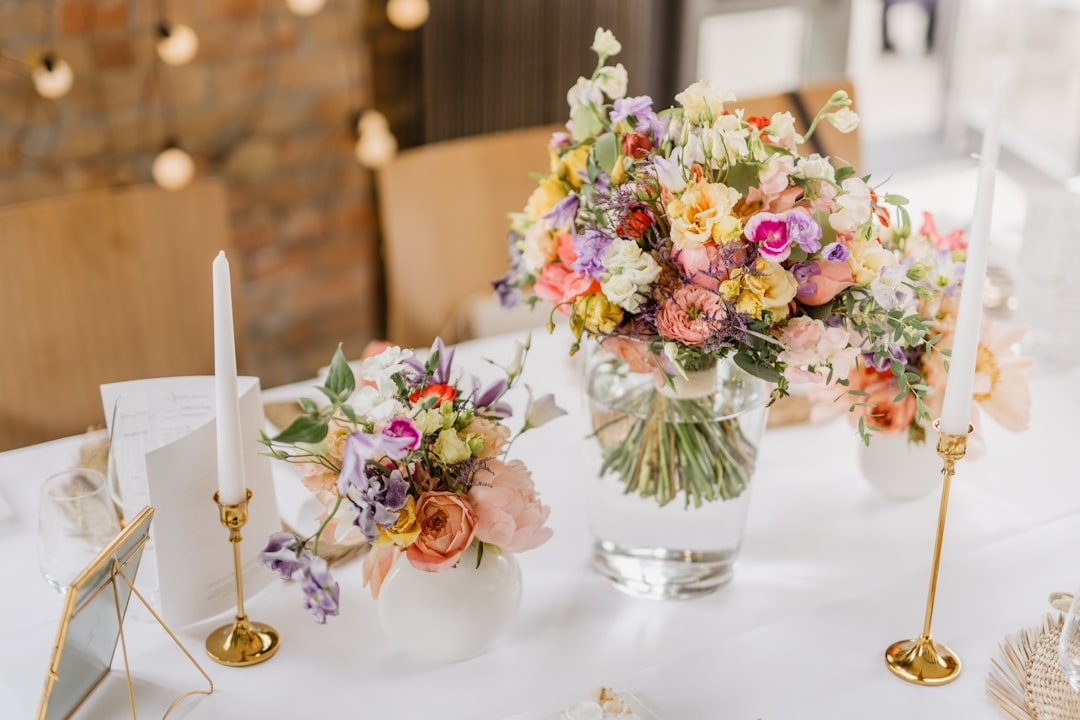
Low centerpieces — arrangements that sit below eye level, typically 8–14 inches tall — are the workhorses of wedding reception design. They don’t obstruct conversation, they’re stable, and they’re relatively fast to make. A classic low centerpiece in a 6-inch compote vase uses 15–25 stems and takes an experienced arranger about 20–30 minutes to build. For a first-timer, budget 45–60 minutes per arrangement.
The most efficient low centerpiece for DIYers uses a grid of floral tape across the vase mouth (2–3 strips each direction creates a grid that holds stems in place without foam) and a base of foliage before any blooms are added. This “foliage first” method reduces the number of expensive focal flowers needed by up to 30%.
High Centerpieces: Drama with a Budget
Tall centerpieces — cylinder vases, candelabras, or raised compotes — create a dramatic, ballroom-appropriate look. They cost more per arrangement but cover more visual space, which means you can use fewer of them. A common strategy is to alternate tall and low centerpieces: tall arrangements on every other table, low arrangements or candlescape-only tables in between. This cuts your tall centerpiece count in half while maintaining visual variety.
For a DIY tall centerpiece in a 24-inch cylinder vase, you’ll need a foam cage or a wide-mouthed insert to hold stems. Plan on 35–50 stems per arrangement, including trailing elements like hanging amaranthus or wisteria vine that extend below the vase rim for a lush, overflowing effect.
Centerpiece Alternatives Worth Considering
Not every table needs a traditional floral centerpiece. A grouping of three to five bud vases — each holding 1–3 stems of a different flower — creates an intimate, collected look that’s far easier to execute than a single compound arrangement. Scatter them with small pillar candles and a few loose petals, and the result looks intentional and editorial. Total flower cost per table: $15–$30.
Personal Flowers: Boutonnieres, Corsages, and Flower Crowns
Personal flowers are small in scale but significant in detail. A boutonnière sits at eye level in hundreds of photographs. A flower crown is photographed from above, below, and straight on. The quality of your mechanics — how well you wire and tape — shows up clearly at this scale.
Boutonnieres That Actually Stay Put
The most common boutonnière failure is a bloom that flops forward within an hour of pinning. The fix is proper wiring. For fleshy flowers like garden roses or ranunculus, insert a 24-gauge floral wire through the base of the bloom, bend it parallel to the stem, and wrap the entire length in floral tape. This creates an internal armature that holds the bloom upright regardless of how many times the groom’s jacket is hugged or jostled. Each boutonnière takes about 10 minutes to construct properly.
Flower Crowns: Design and Durability
Flower crowns require flowers with good staying power. Avoid heavily fragrant, delicate varieties like sweet peas or lily of the valley — they wilt fastest and shed petals. Excellent crown flowers include wax flower (extraordinarily durable), spray roses, small chrysanthemums, lavender, and dried or preserved elements. A crown for a full-day event should be made the morning of the wedding, kept refrigerated until 30 minutes before it’s needed, and misted with water mixed with a drop of floral preservative spray.
Sourcing Your Wedding Flowers: Wholesale, Farm-Direct, and Your Own Garden
Where you get your flowers matters as much as which flowers you choose. Each sourcing channel has different lead times, minimum orders, and quality considerations.
Wholesale Flower Markets
US cities with active wholesale flower markets include Los Angeles (the LA Flower District), New York (the West 28th Street market), Miami (one of the largest import hubs in the country), and Chicago. Most wholesale markets require a resale license to purchase, though some vendors will sell to consumers on weekends or during certain hours. Prices run 50–75% below retail. The trade-off is that you need to pick up in person, and availability changes daily.
Online Wholesale and Farm-Direct Suppliers
For gardeners outside major metro areas, online wholesale suppliers are a game-changer. Companies like Mayesh Wholesale, FiftyFlowers, Blooms by the Box, and Farm Direct Wholesale ship flowers in bulk directly to your door. Orders typically arrive 2–5 days before your event. Minimum orders range from $100–$200. Quality is generally excellent — these companies ship to professional florists regularly — but you’re buying without seeing the specific stems, so order variety names and grades carefully.
Your Own Cutting Garden
If you have a cutting garden, growing wedding flowers is one of the most satisfying projects you can undertake. Start planning 12–18 months out. For a summer wedding, direct sow zinnias, cosmos, and bachelor’s button in spring; start dahlias from tubers in May; plant sweet peas in fall for Zone 7+ or early spring for cooler zones. A 4×8-foot cutting bed, well managed, can yield 150–200 stems per week at peak season — enough to supplement purchased flowers significantly.
The key limitation of garden-grown flowers is uniformity and timing. Professional wholesale flowers are graded for consistent stem length and bloom stage. Your garden will produce a glorious mix of sizes and stages. That’s actually an advantage in loose, garden-style arrangements — but if you’re building tight round bouquets that need identical bloom sizes, you may need to supplement with purchased stems for consistency.
Wedding Flower Timeline: When to Do What
The single biggest mistake DIY wedding florists make is underestimating how long everything takes. Here’s a realistic timeline:
- 6–12 months out: Finalize palette, decide which elements to DIY vs. hire out, start cutting garden if growing your own
- 3–4 months out: Place pre-orders with wholesale or farm-direct suppliers (especially for peak summer dates), rent or purchase vessels and mechanics
- 2–4 weeks out: Do a full practice run of the bridal bouquet and one centerpiece
- 4–5 days out: Flowers arrive; unbox immediately, recut stems, hydrate in buckets in a cool space (a garage or basement works well)
- 2 days out: Build any garlands, greenery bases, or pre-wired elements; make boutonnières and corsages; store in plastic bags in the refrigerator
- 1 day out: Build centerpieces; store in a cool, dark room with high humidity
- Morning of: Build bridal and bridesmaid bouquets; do final touch-ups; deliver and install
Build in a two-hour buffer on the morning of the wedding. Something will take longer than expected. That buffer is the difference between a calm morning and a panicked one.
Practical Tips for DIY Wedding Flower Success
The Right Tools Make the Difference
You don’t need a professional florist’s full toolkit, but a few specific items are non-negotiable: sharp floral snips (not scissors — snips cut cleanly without crushing stems), a stem stripper for high-volume defoliating, floral tape (both green and brown), 22- and 24-gauge floral wire, a mechanics kit (frogs, tape, chicken wire), and food-grade buckets in multiple sizes. Budget $80–$120 for a solid DIY toolkit if you’re starting from scratch.
Hydration Is Everything
Flowers need water constantly from the moment they’re cut. Every hour a stem sits without water shortens its vase life. Keep cut stems in water while you work — use a bucket beside your worktable and only remove a stem when you’re actively working with it. For finished arrangements that won’t be placed immediately, keep them in water in a cool room and cover loosely with a plastic bag to retain humidity.
Temperature Management on the Day
Heat is the enemy of cut flowers. On a summer wedding day above 80°F, flowers can wilt within 2–3 hours of being out of water. Deliver flowers in an air-conditioned vehicle, not a hot trunk. Set up ceremony and reception flowers as late as logistically possible. If outdoor temperatures are extreme, consider mixing in some dried or preserved elements that won’t be affected by heat.
Fragrance Considerations
Fragrance is a beautiful element in wedding flowers — but it requires thought. Strongly scented flowers like lily, gardenia, tuberose, and stephanotis can cause headaches or trigger allergies in enclosed spaces. If the reception is in a tent or a small indoor venue, use fragrant flowers sparingly and concentrate them in outdoor or high-ceiling areas. Garden roses and peonies offer moderate fragrance that reads as romantic rather than overwhelming.
Wedding Flowers vs. Silk/Artificial Flowers: The Real Comparison
The case for artificial flowers at weddings has gotten stronger in recent years. High-end silk flowers — particularly those from suppliers like Nearly Natural or imported from skilled manufacturers — can be visually convincing in photographs and last indefinitely as keepsakes. They’re also unaffected by heat, require no water logistics, and can be ordered months in advance.
The case against them is sensory and tactile. Real flowers have weight, fragrance, and a living quality that reads differently in person, especially in close-up photographs and when carried. The slight imperfections in a real peony — the way petals unfurl differently on each bloom, the variation in color depth — create visual richness that even excellent silk flowers can’t replicate.
The smart approach for many gardener-led weddings is a hybrid: real flowers for the bridal bouquet and personal flowers (where quality matters most and is seen up close), artificial or preserved flowers for large structural elements like ceremony arches or garlands that need to be built days in advance or will be exposed to extreme heat. This approach captures the best of both without the full logistics burden of all-fresh flowers.
Frequently Asked Questions
How far in advance should I order wedding flowers?
For peak wedding season (May–October), order wholesale flowers 3–4 months in advance to secure specific varieties and grades. Online farm-direct suppliers typically need 4–8 weeks notice for large orders. If ordering from a local wholesaler or market, 2–4 weeks is usually sufficient, though popular varieties like garden roses and peonies can sell out faster during busy weekends.
How many flowers do I need for a wedding with 100 guests?
A rough estimate for a 100-guest wedding with 10 tables: 1 bridal bouquet (40–55 stems), 4 bridesmaid bouquets (20–25 stems each), 10 centerpieces (15–25 stems each low, or 35–50 stems each tall), plus ceremony flowers, boutonnières, and accent pieces. Total stem count typically falls between 600–1,000 stems for a full floral package at this guest count.
What are the most durable flowers for an outdoor summer wedding?
The most heat-tolerant cut flowers for outdoor summer weddings include zinnias, marigolds, sunflowers, lisianthus, celosia, globe amaranth, and tropical varieties like protea and anthuriums. Garden roses hold up better than hybrid teas in heat. Avoid sweet peas, lily of the valley, anemones, and ranunculus for outdoor summer installations — they wilt quickly above 75°F.
Can I grow enough flowers in my garden for a wedding?
Yes — but with realistic expectations. A dedicated 200–300 square feet of well-managed cutting garden can supply a significant portion of flowers for a small to medium wedding (50–80 guests) during peak season. You’ll likely need to supplement with purchased flowers for consistency and quantity. The most practical approach is to grow unusual, high-value flowers that are expensive to buy (sweet peas, lisianthus, garden-grown dahlias) and purchase commodity flowers (roses, fillers) at wholesale.
What’s the best way to keep a bridal bouquet fresh all day?
Make the bouquet the morning of the wedding. Keep it in a vase of water in a cool room until 30 minutes before the ceremony. Mist lightly with water before carrying. During cocktail hour, return the bouquet to water if possible. Avoid direct sunlight, heat vents, or air conditioning blowing directly on it. Flowers conditioned properly for 24–48 hours before arranging will hold their form and freshness for 8–10 hours in normal indoor conditions.
Planning Your Next Step: From Ideas to Action
The best time to start your wedding flower planning is right now, even if the wedding is a year away. Pull out a notebook and sketch your palette — just three to five colors, nothing more. Walk your garden and list what’s blooming or what you could grow. Pull up the wholesale price list for one online supplier and price out your centerpiece concept with real numbers.
That practice run two to four weeks before the wedding? Don’t skip it. Make a full-scale bridal bouquet with the actual flowers you’ve ordered. Photograph it. Time yourself. Identify what doesn’t work before the morning of the event, when there’s no margin for adjustment. Gardeners who treat wedding floristry like any other serious garden project — with planning, practice, and honest assessment — consistently produce work that rivals professional florists at a fraction of the cost.
Your cutting garden knowledge, your eye for color, your understanding of how plants behave — those are assets that took years to build. A wedding is one of the finest stages on which to use them.