The Ultimate Guide to Growing Flowers from Seed Indoors
15 min read
Contents:
- Why Start Flowers Indoors at All?
- Growing Flowers from Seed Indoors: Essential Supplies
- Containers and Trays
- Seed-Starting Mix vs. Potting Soil
- Light: The Factor Most Beginners Underestimate
- When to Start: Timing Your Indoor Seed Start
- Regional Timing Differences
- Step-by-Step: How to Sow Flower Seeds Indoors
- Step 1: Pre-Moisten Your Growing Medium
- Step 2: Fill Trays and Sow Seeds
- Step 3: Create a Humid Environment for Germination
- Step 4: The Moment Germination Happens — Adjust Immediately
- Caring for Seedlings: From Sprout to Transplant-Ready
- Watering
- Fertilizing Seedlings
- Thinning: The Hardest Part
- Hardening Off: The Step You Cannot Skip
- Troubleshooting Common Seedling Problems
- Damping Off
- Leggy, Spindly Growth
- Yellow Leaves
- No Germination After 3 Weeks
- Seed Starting Indoors vs. Direct Sowing Outdoors
- Best Flowers to Grow from Seed Indoors
- Easiest Flowers to Start Indoors
- Intermediate Difficulty
- Challenging (Worth the Effort)
- Practical Tips for Better Results
- FAQ: Growing Flowers from Seed Indoors
- How early should I start flower seeds indoors?
- What is the best grow light for starting flower seeds indoors?
- Why are my flower seedlings falling over?
- Can I use regular potting soil instead of seed-starting mix?
- When should I transplant flower seedlings outdoors?
- Planning Your Best Seed-Starting Season Yet
What if the most expensive part of your garden could cost you almost nothing? Growing flowers from seed indoors is one of the most rewarding — and budget-savvy — skills a gardener can develop. A single packet of zinnia seeds runs about $3 and can yield 50 or more plants. Buy those same zinnias as transplants at a garden center? You’re looking at $5 to $8 per six-pack. Do that math across an entire garden bed, and starting from seed stops being a hobby and starts being a strategy.
But saving money is just the beginning. When you start flowers indoors, you gain access to a staggering variety of cultivars that never appear on nursery shelves. You control the growing conditions from day one. And there’s something genuinely satisfying about watching a seedling you coaxed out of a tiny seed unfurl its first true leaves under your grow lights in February, weeks before the last frost has even thought about leaving.
This guide covers everything — from choosing the right seeds and containers to diagnosing why your seedlings are flopping over. Whether you’ve killed a flat of petunias before or you’re completely new to this, you’ll find actionable guidance here.
Why Start Flowers Indoors at All?
Not every flower needs a head start indoors. Sunflowers, nasturtiums, and California poppies actually prefer to be direct-sown because they resent root disturbance. But a long list of popular flowers — including snapdragons, petunias, impatiens, lobelia, and verbena — have such long growing seasons that they’d never bloom if you waited until outdoor planting time to start them.
Lobelia, for example, takes 10 to 12 weeks from seed to transplant-ready size. In a northern state like Minnesota, where the last frost often falls in mid-May, you’d need to start lobelia seeds in late February or early March to have blooming plants by early summer. Plant them in May from seed outdoors? You’d be lucky to see color by August.
Starting indoors also gives you a buffer against unpredictable spring weather. A late frost that devastates direct-sown seedlings won’t touch your protected indoor starts. You’re buying insurance against the chaos of nature — with a packet of seeds and a warm windowsill.
Growing Flowers from Seed Indoors: Essential Supplies
You don’t need a fancy setup. Many experienced gardeners started with a sunny south-facing window, some recycled yogurt containers, and a bag of seed-starting mix. That said, the right tools make a measurable difference in germination rates and seedling health.
Containers and Trays
Standard 72-cell plug trays are the workhorses of seed starting. Each cell holds roughly 1.5 inches of growing medium — enough to support a seedling until its first true leaves appear. For large seeds like marigolds or cosmos, 50-cell trays give roots more room. Biodegradable peat pots and coir pellets work well for flowers that don’t like transplanting, like larkspur and sweet peas.
Whatever container you use, drainage is non-negotiable. Sitting water is the fastest route to damping off, a fungal condition that kills seedlings at the soil line seemingly overnight.
Seed-Starting Mix vs. Potting Soil
Here’s where many beginners go wrong: using regular potting soil for seed starting. Standard potting mix is too heavy and often too nutrient-rich for germination. Seedlings don’t need fertilizer — they need moisture retention, aeration, and a sterile environment that won’t harbor the fungal pathogens that cause damping off.
A good seed-starting mix is typically made of fine peat moss or coir, perlite, and sometimes vermiculite. It’s light, drains quickly, and holds just enough moisture to support germination. Brands like Espoma Organic Seed Starter and Pro-Mix HP are reliable choices, both available at most garden centers for $10 to $18 for an 8-quart bag.
Commercial greenhouse growers bottom-water their seed trays almost exclusively. Instead of watering from above — which can displace tiny seeds and promote fungal growth on the soil surface — they set their trays in a shallow reservoir of water and let the mix wick moisture upward. Try setting your seed tray inside a standard 1020 flat with no holes and adding an inch of water. Check every 30 minutes; once the surface of the mix feels barely damp, remove the tray and let it drain. This single change can dramatically reduce damping off and produces sturdier seedlings.
Light: The Factor Most Beginners Underestimate
A sunny south-facing window sounds ideal, and it can work — but only if you live somewhere with reliably bright winters and keep your seedlings within 6 inches of the glass. In most of the US, winter light is simply too weak and too short to grow stocky seedlings on a windowsill alone. The result is etiolated plants: tall, pale, spindly seedlings that stretch desperately toward the light and collapse under their own weight.
A basic two-bulb T5 fluorescent or LED grow light fixture, positioned 2 to 3 inches above the seedling tops and running 14 to 16 hours per day, solves this problem completely. Entry-level LED grow light strips with a full-spectrum output run $30 to $60 on Amazon and can last several growing seasons. Keep the lights on a timer — consistency matters more than total intensity at the seedling stage.
When to Start: Timing Your Indoor Seed Start
Timing is the single most common mistake in indoor seed starting. Start too early and you end up with enormous, root-bound seedlings you can’t plant outside yet. Start too late and you’ve negated the advantage of starting indoors at all.
The formula is simple: find your average last frost date, then count backward by the number of weeks specified on the seed packet. Most flower seeds need 6 to 10 weeks of indoor growing time before transplanting. Petunias need 10 to 12 weeks. Marigolds are fast — 4 to 6 weeks is enough. Snapdragons land in the middle at about 8 to 10 weeks.
Regional Timing Differences
Gardeners in different parts of the country operate on dramatically different schedules, and this is one area where generic advice can genuinely mislead you.
In the Northeast — think Massachusetts, upstate New York, Vermont — last frost dates commonly fall between May 1 and May 15 in most areas, though higher elevations push that into late May. Seed starting typically begins in late February or early March for most annuals.
In the South — Georgia, Alabama, the Gulf Coast — last frost dates often fall in February or early March, sometimes even January in deep South Florida. Gardeners there may start seeds in December or January and are dealing with a completely different challenge: the brutal summer heat that arrives by June and shuts down cool-season flowers entirely. Snapdragons, which thrive in 45°F to 65°F temperatures, are planted in fall in zones 8 to 10 for winter bloom.
On the West Coast, particularly in coastal California, frost is often a non-issue. Gardeners in San Francisco or San Diego operate more by rainfall and fog patterns than frost dates. The mild, consistent climate allows year-round seed starting in many areas, and the challenge becomes less about cold and more about keeping seedlings from getting leggy in fog-dimmed winters.
Your most reliable timing tool is the Old Farmer’s Almanac frost date calculator at almanac.com, which gives last frost dates by zip code. Cross-reference that with your seed packets and you’ll have a personalized sowing schedule within minutes.
Step-by-Step: How to Sow Flower Seeds Indoors
Step 1: Pre-Moisten Your Growing Medium
Dry seed-starting mix is hydrophobic — it repels water rather than absorbing it. Before filling your trays, pour your mix into a large bucket or bin, add warm water, and mix until the medium clumps slightly when squeezed but doesn’t drip. It should feel like a wrung-out sponge. Filling trays with dry mix and then trying to water it is an exercise in frustration.
Step 2: Fill Trays and Sow Seeds
Fill each cell to about a quarter-inch below the rim. Gently firm the surface — not compacted, just even. Sow seeds according to packet depth instructions. A useful rule of thumb: cover seeds to a depth of roughly twice their diameter. Dust-fine seeds like petunias and begonias get no covering at all; they need light to germinate. Drop them on the surface and press gently with your fingertip.
Label everything. This sounds obvious until you’re staring at 12 identical trays of tiny green sprouts in March and can’t remember which is which.
Step 3: Create a Humid Environment for Germination
Most flower seeds germinate best at soil temperatures between 65°F and 75°F, with some — like impatiens and celosias — preferring 70°F to 80°F. A plastic dome cover or even a layer of plastic wrap creates a miniature greenhouse effect that holds humidity and warmth. Remove the cover as soon as you see sprouts emerging — leaving it on too long creates the warm, wet conditions that fungal pathogens love.
A seedling heat mat set to 70°F can boost germination rates significantly, especially in cooler homes. Studies on germination physiology consistently show that soil temperature has a greater effect on germination speed and percentage than air temperature. For cold-sensitive seeds like impatiens and vinca, a heat mat can cut germination time nearly in half.
Step 4: The Moment Germination Happens — Adjust Immediately
The window between germination and leggy seedlings is short. The moment you see the first seedlings emerging — even before the whole tray has sprouted — get your grow lights on. Move them to within 2 to 3 inches of the tops of the seedlings. Light deprivation in the first 48 hours of emergence is enough to produce etiolated plants that never fully recover their vigor.
Caring for Seedlings: From Sprout to Transplant-Ready
Watering
Overwatering kills more seedlings than underwatering does. The goal is to keep the growing medium evenly moist — never saturated, never bone dry. Check your trays daily. Lift them; a light tray is dry. A heavy one is adequately moist. When the top of the mix starts to look lighter in color and the tray feels noticeably lighter, it’s time to water.
Fertilizing Seedlings
Seed-starting mix contains little to no nutrients by design — seedlings live off the energy stored in the seed itself for their first week or two. Once the first true leaves appear (the second set of leaves, which look like miniature versions of the adult plant’s foliage), begin feeding with a diluted liquid fertilizer.
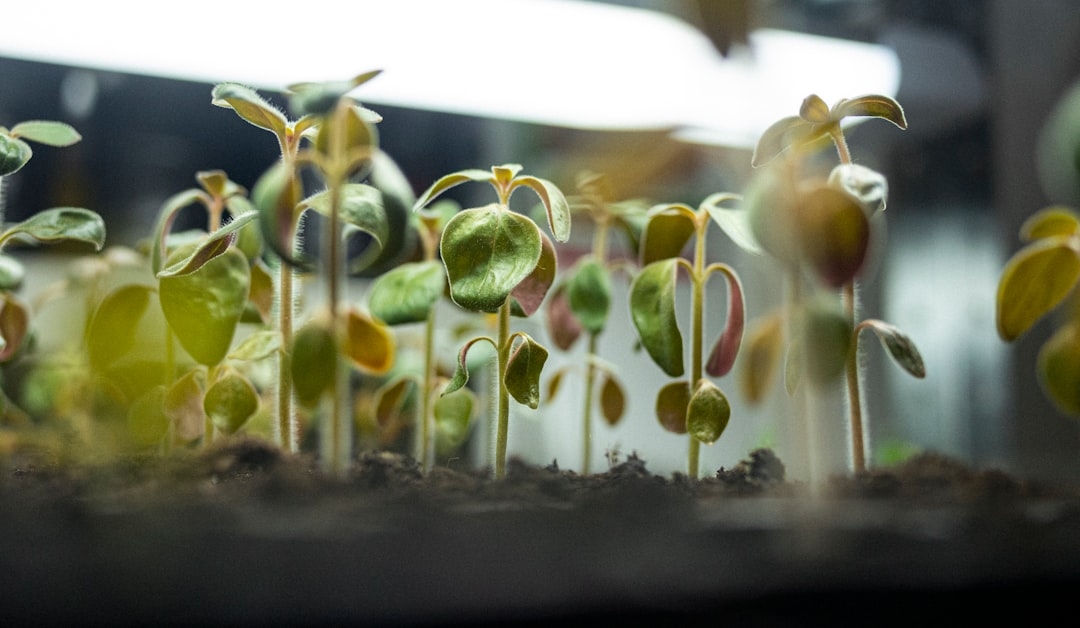
A half-strength solution of balanced liquid fertilizer like fish emulsion (5-1-1) or a product like Fox Farm Grow Big works well. Feed once a week at most. Over-fertilizing causes fertilizer burn and produces soft, sappy growth that’s more susceptible to pests and disease. Less is reliably more here.
Thinning: The Hardest Part
If multiple seeds germinate in a single cell, you need to thin to one seedling per cell. This is emotionally difficult for most gardeners. Do it anyway. Crowded seedlings compete for light and nutrients, and the result is uniformly weak plants rather than one strong one. Use small scissors to snip the extras at soil level — don’t pull them out, which risks disturbing the roots of the keeper.
Hardening Off: The Step You Cannot Skip
Transplanting seedlings directly from a controlled indoor environment to the outdoors is a shock that can kill or severely set back even healthy plants. The process of gradually acclimating seedlings to outdoor conditions is called hardening off, and it typically takes 7 to 14 days.
Start by setting your seedlings outside in a sheltered, shaded spot for 1 to 2 hours on the first day. Over the following week, increase outdoor exposure by an hour or two each day, gradually introducing direct sun. By the end of two weeks, they should be spending full days outside and can be left out overnight if temperatures stay above 50°F. Rushing this process even by a day or two can cause sunscald, wilting, and dramatic transplant shock.
Troubleshooting Common Seedling Problems
Damping Off
Damping off is caused by several soil-borne fungi, most commonly Pythium and Rhizoctonia species. Affected seedlings appear to have been pinched off at the soil line — they simply fall over and die, often in patches that spread outward. Prevention is far more effective than treatment: use sterile seed-starting mix, ensure excellent air circulation with a small fan, avoid overwatering, and bottom-water whenever possible. Once damping off appears, affected seedlings cannot be saved, but spreading can be slowed by removing them immediately and improving air circulation for the remaining plants.
Leggy, Spindly Growth
The cause is almost always insufficient light. Move your grow lights to within 2 inches of seedling tops, or add a second light source. Increasing daily light duration to 16 hours can also help, though beyond 16 to 18 hours, most plants don’t benefit further. Some gardeners place a small oscillating fan near seedlings — the gentle physical stress of moving air actually triggers thicker stem development, a process called thigmomorphogenesis. Even 10 minutes of gentle air movement twice a day produces measurably sturdier stems.
Yellow Leaves
Yellowing in young seedlings most often points to one of three issues: overwatering (roots can’t uptake nutrients in waterlogged soil), nitrogen deficiency (begin fertilizing if seedlings have true leaves), or root-bound conditions (time to pot up to a larger container). Check the roots by gently tipping a seedling out of its cell — tightly circling, densely packed roots mean the plant has outgrown its space.
No Germination After 3 Weeks
Most flower seeds germinate within 7 to 21 days under good conditions. If nothing has appeared after three weeks, the likely culprits are: soil temperature too low, seeds buried too deep, old seed with low viability, or seeds that require light for germination but were covered. Check your specific flower’s requirements — some seeds, like columbine and delphinium, need a cold stratification period before they’ll germinate at all.
Seed Starting Indoors vs. Direct Sowing Outdoors
Starting seeds indoors and direct sowing outdoors aren’t competing approaches — they’re complementary techniques suited to different plants and goals. Understanding which method serves each flower best saves time, money, and frustration.
Start indoors when: the flower has a long season-to-bloom time (10+ weeks), the seed is tiny and easily lost or displaced outdoors, the plant is tender and needs protection from late frosts, or you want earlier blooms than your climate otherwise allows. Examples: petunias, impatiens, begonias, lobelia, snapdragons, verbena.
Direct sow outdoors when: the flower has a taproot and resents transplanting, the seed germinates rapidly (within 5 to 10 days), or the plant is extremely cold-tolerant and can be sown as soon as soil can be worked. Examples: sunflowers, nasturtiums, zinnias (though zinnias can also be started indoors for earliest blooms), larkspur, bachelor’s button, sweet alyssum.
The common misconception is that starting indoors is always superior. In reality, direct-sown sunflowers often catch up to and surpass indoor-started ones within weeks, because transplanting sunflowers — even carefully — slows their growth. The root disruption costs more time than the head start gained.
Best Flowers to Grow from Seed Indoors
Some flowers are spectacularly forgiving for first-time seed starters. Others are fussy enough to test experienced gardeners. Here’s an honest breakdown:
Easiest Flowers to Start Indoors
- Marigolds (Tagetes spp.) — Germinate in 4 to 7 days, grow quickly, rarely suffer from damping off. Start 4 to 6 weeks before last frost.
- Cosmos (Cosmos bipinnatus) — Fast and nearly foolproof. 5 to 7 days to germination, 6 to 8 weeks to transplant size. Excellent for beginners.
- Zinnias (Zinnia elegans) — Germinate in 5 to 7 days. Start just 4 weeks before transplanting; they grow quickly and resent staying in small cells too long.
- Celosia (Celosia argentea) — Vibrant and fast, 7 to 14 days to germination. Needs warmth (70°F+) to sprout well.
Intermediate Difficulty
- Petunias — Tiny seeds that need light to germinate. Takes 10 to 12 weeks. Rewarding once you nail the surface-sowing technique.
- Snapdragons (Antirrhinum majus) — Need light for germination and cool temperatures (60°F to 65°F) to grow best. Start 10 weeks before last frost.
- Verbena — Erratic germination (7 to 21 days). Benefits from cold stratification or chilling seeds in the refrigerator for 7 days before sowing.
Challenging (Worth the Effort)
- Begonias (Begonia × semperflorens) — Seeds are almost microscopic and need light and high humidity to germinate. Start 16 to 18 weeks before last frost. Mix seeds with fine sand to distribute evenly.
- Delphinium — Requires cold stratification and prefers germination temperatures below 65°F. Finicky but spectacular when it works.
- Impatiens — Seeds need light, consistent warmth (75°F to 80°F), and precise moisture. Start 10 to 12 weeks out.
Practical Tips for Better Results
- Use a seedling journal. Note your sow dates, germination dates, any problems observed, and transplant dates. After two seasons, you’ll have customized timing data for your specific climate and growing setup that no seed packet can replicate.
- Sow in succession. Instead of starting all your petunias at once, sow a flat every two weeks. This staggers bloom time and extends your color display through the season.
- Check seed viability before committing. Old seeds from the back of the drawer may have low germination rates. Test by placing 10 seeds on a damp paper towel, folding it, and setting it in a warm place. Check after the packet’s stated germination time. If fewer than 7 of 10 sprout, sow more densely or buy fresh seed.
- Pot up at the right time. When roots begin emerging from the bottom of your cells, or when the seedling has two sets of true leaves and looks cramped, move it to a 3- to 4-inch pot. Letting plants stay root-bound stunts growth that may take weeks to recover from after transplanting.
- Keep records of your seed sources. Not all seed companies are equal. Companies like Baker Creek Heirloom Seeds, Johnny’s Selected Seeds, and Floret Flower Farm consistently produce high-germination seed with detailed growing notes. Budget seeds from discount bins often have lower viability and poor variety selection.
FAQ: Growing Flowers from Seed Indoors
How early should I start flower seeds indoors?
Most flower seeds should be started 6 to 12 weeks before your last expected frost date, depending on the species. Petunias, impatiens, and begonias need 10 to 16 weeks. Fast growers like marigolds and zinnias need only 4 to 6 weeks. Check your seed packet and count backward from your local last frost date to set your sowing schedule.
What is the best grow light for starting flower seeds indoors?
A full-spectrum LED or T5 fluorescent grow light is ideal. Look for a fixture rated between 2,000 and 4,000 lumens for a standard seedling tray. Position lights 2 to 3 inches above seedling tops and run them 14 to 16 hours per day on a timer. Budget LED strips in the $30 to $60 range work well for hobby-scale seed starting.
Why are my flower seedlings falling over?
Seedlings that fall over at the soil line have likely been affected by damping off, a fungal disease caused by overwatering and poor air circulation. Seedlings that are just tall and floppy are etiolated — they’re stretching toward insufficient light. Improve air circulation, reduce watering frequency, and move grow lights closer to seedling tops to prevent both issues.
Can I use regular potting soil instead of seed-starting mix?
Regular potting soil is too dense, may not be sterile, and often contains nutrient levels that can burn tender seedlings. Seed-starting mix is lighter, more porous, and sterile — which dramatically reduces damping off risk. Use potting soil when potting up seedlings to larger containers, but start with a dedicated seed-starting mix.
When should I transplant flower seedlings outdoors?
Transplant after your last frost date once seedlings have been hardened off for 7 to 14 days. Harden off by gradually increasing outdoor exposure over 1 to 2 weeks, starting with a few hours of shade and working up to full sun and overnight stays. Transplant on a cloudy day or in the late afternoon to reduce transplant stress.
Planning Your Best Seed-Starting Season Yet
The first year of starting flowers from seed is the hardest. You’re building intuition — learning how your particular home, light levels, and watering habits interact with tiny plants that have very specific needs. Some seeds won’t germinate. Some seedlings will damp off. A few flats will be leggy. That’s not failure; that’s the process.
By your second or third season, the whole workflow becomes fluid. You’ll know that your kitchen averages 68°F in March and that your south-facing window isn’t quite enough for petunias but works fine for marigolds. You’ll have a timing chart based on your zip code and your specific setup. You’ll have opinions about seed companies. You’ll have a favorite seedling mix.
Start with two or three easy species — marigolds, cosmos, zinnias — and do them well before adding the fussier ones. Get your light setup dialed in. Learn bottom-watering this season. Each small system you put in place compounds over time into a spring ritual you’ll genuinely look forward to.
Your garden center still has its place. But when you walk past those $7 six-packs of petunias in May, you’ll know exactly what you grew from a $3 packet of seeds — and how much more you’re growing next year.